01
Daily reflections
Begin with truth each day through carefully structured prompts that invite honest self-examination without sounding cold, clinical or generic.
Purpose-built for the work of recovery, not a general chatbot with recovery prompts on top. There at 3am when nothing else is open — whatever path you’re on, at whatever pace it takes.
784 stepwork questions · Six recovery paths · Your journal stays on your phone
Most recovery apps feel clinical, cluttered, or impersonal. Twelva is different. It's a calm, guided companion that meets you where you are — whatever path you draw from. Work the Twelve Steps at your own pace, draw on a Library of guided reading & study plans across recovery paths, talk to the Sponsor Companion in hard moments, breathe, check in, and keep a private recovery journal. Just you and the work.
Structured stepwork across the Twelve Steps — 784 honest questions, roughly a month per step — plus a Library of guided reading & study plans across recovery paths. Never preachy, never clinical, never graded.
Your journal stays on your device. Cloud sync is opt-in and off until you turn it on. We never sell your data and never use it to train models.
A daily experience — a reflection, a breath, a check-in — alongside breathing tools, HALT, sobriety streaks, milestone badges, and a private journal. Steady progress, not overwhelm.
A general assistant is built to be useful about ten thousand subjects. The Sponsor Companion has one: keeping you engaged with your own recovery — which is not always the same as making you feel better in the moment.
What it will never do. Diagnose you, prescribe anything, or tell you to change how you take your medication. Replace a sponsor, a meeting, a therapist or a doctor. Pretend to be a person. And if a message ever fails to send, you get an honest error — never a comforting paragraph written by something other than the Companion.
“AI-powered” on its own means almost nothing. This is what it means here: the Companion knows roughly where you are, across fifteen stages from the first twenty-four hours to ten years, and what it watches for changes at every one of them. The risks later are not milder. They are different.
It watches for
Acute symptoms subsiding while sleep and appetite are still wrecked — and the trap of feeling better and deciding you can manage alone now.
It avoids
Stepwork. Insight. Reading lists. Treating improvement as recovery.
It watches for
Quiet overconfidence. Stopping meetings, dropping contact, isolating because you feel functional again.
It avoids
Overselling the milestone. A chip is a marker, not something to live up to.
It watches for
Life coming back — work, relationships, family — and the programme quietly becoming the first thing dropped when it gets busy.
It avoids
Talking to you like a newcomer. Leading with cravings, which for many people are no longer the daily problem.
It watches for
Resentment accumulating. Relationships repaired or not repaired. Career, money, and “I do not really need this any more.”
It avoids
Craving framing. Checking whether you are still clean. If something has happened, you will say so.
And a slip never costs you the Companion’s respect. How long you have lived in recovery across your whole life is tracked separately from your current streak, and it never goes down. Someone with three years who slipped on Tuesday is in real danger and is a veteran. Handed the newcomer script at their lowest moment, they would never open the app again.
You can. Plenty of people do, and it will often say something kind. These are the differences that actually matter at eleven at night.
| A general assistant | Twelva | |
|---|---|---|
| What it is for | Everything. | Recovery. One objective, and it does not drift off it. |
| Where you are | Starts every conversation from nothing, or from whatever you last asked it about. | Knows roughly how long you have been clean and how much recovery you have lived, and speaks accordingly. |
| After a slip | No particular change in behaviour. | Behaves differently on purpose — and stops drawing on your written context entirely for fourteen days. |
| Your identity | Tied to the account you use for work, email and everything else. | No sign-in, email or name required to talk to it at all. |
| What it remembers | Mixed in with the rest of your chat history. | A short recovery record kept on your phone, which you can read, edit, delete or switch off. |
| The framework | General knowledge about recovery. | 12-Step, SMART, Refuge Recovery, Al-Anon, CBT-informed and secular — you choose, and it uses your language. |
| The rest of it | A conversation. | 784 stepwork questions, daily reflections, HALT, breathing, milestones and a private journal around the conversation. |
None of that makes a general assistant bad. It makes it general. Recovery is the one subject where the difference between “helpful” and “helpful about this, specifically, tonight” is the whole thing.
No dashboard noise. No wellness theatre. Each screen has one job: help you do the next useful thing, then get out of the way.
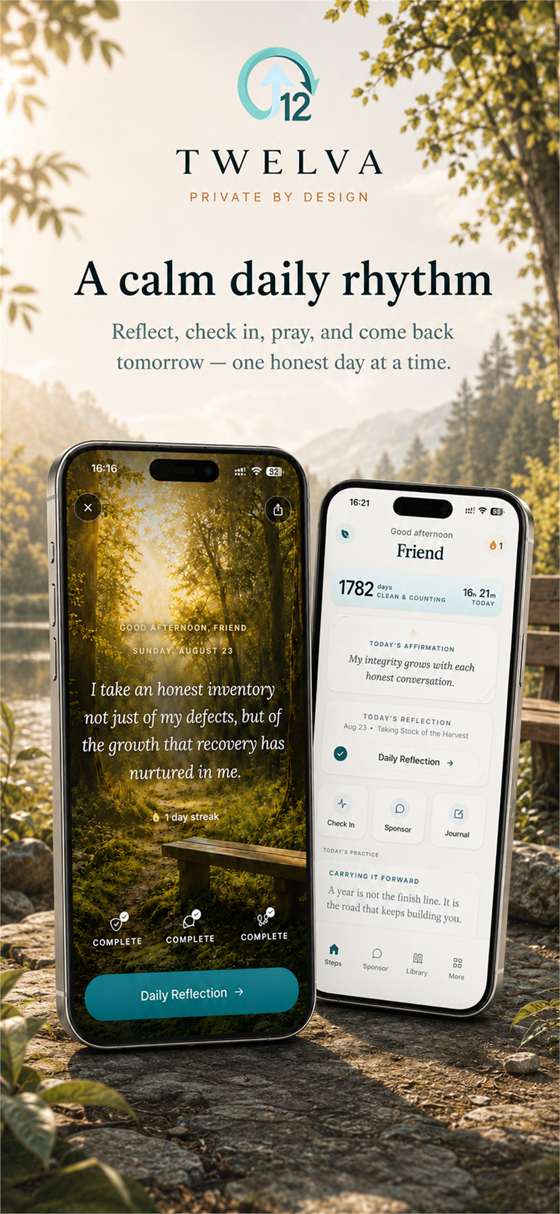
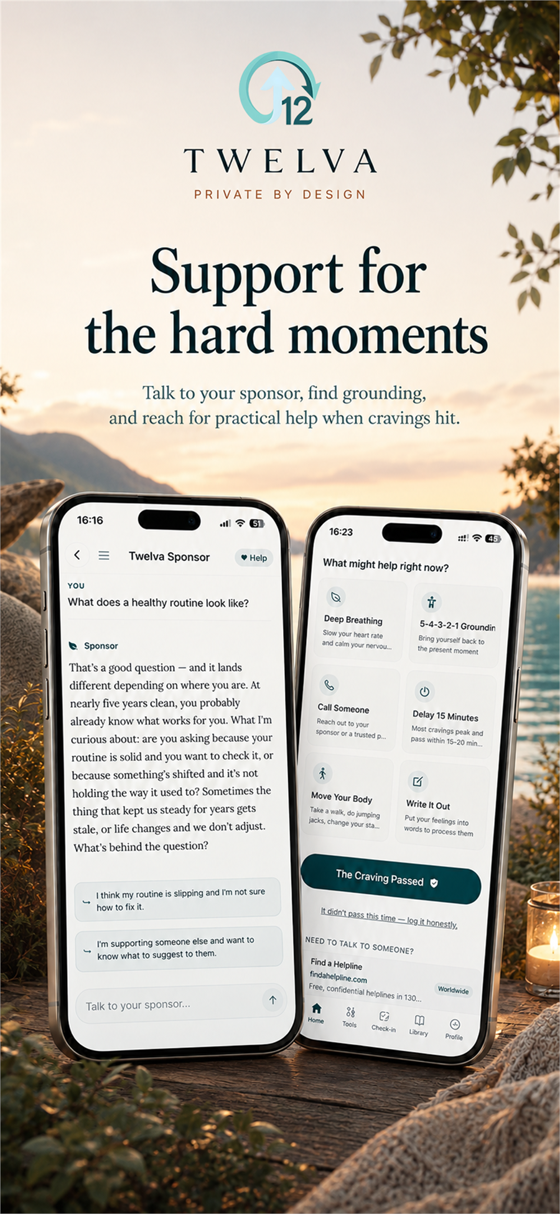
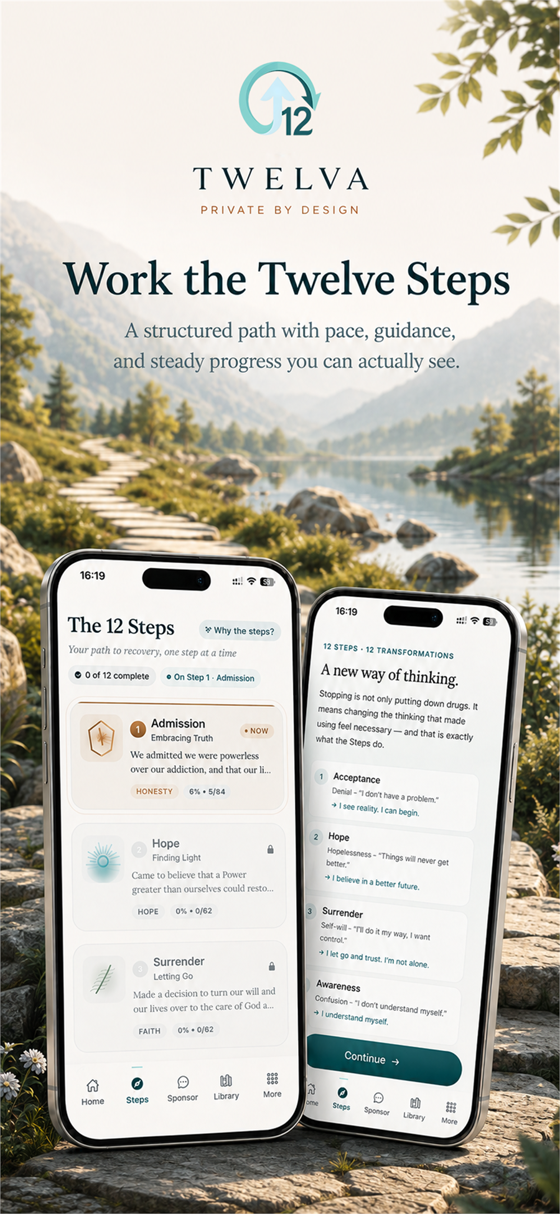
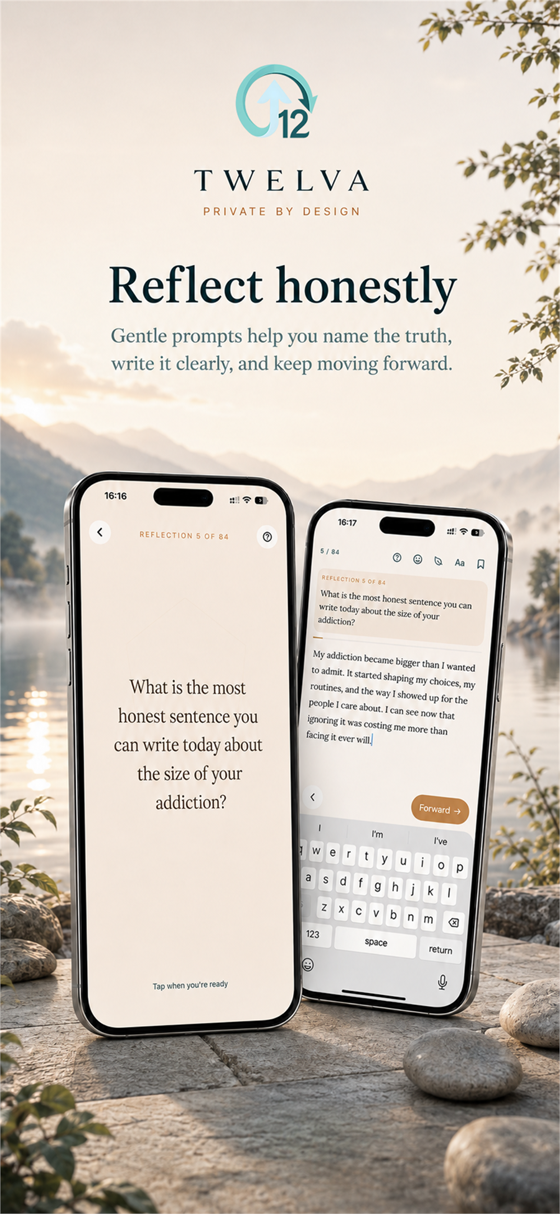
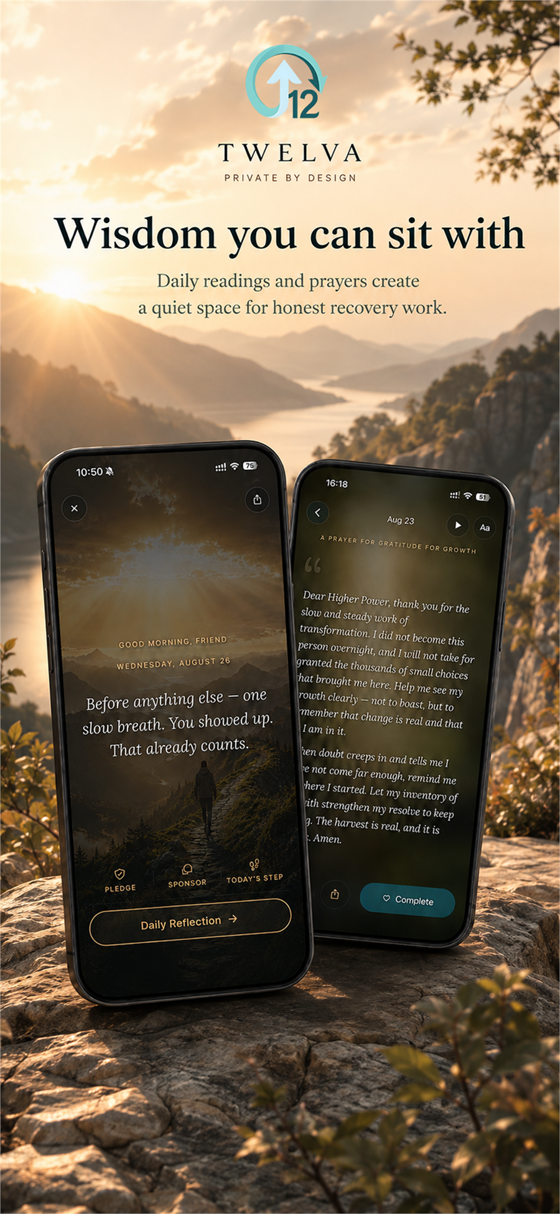
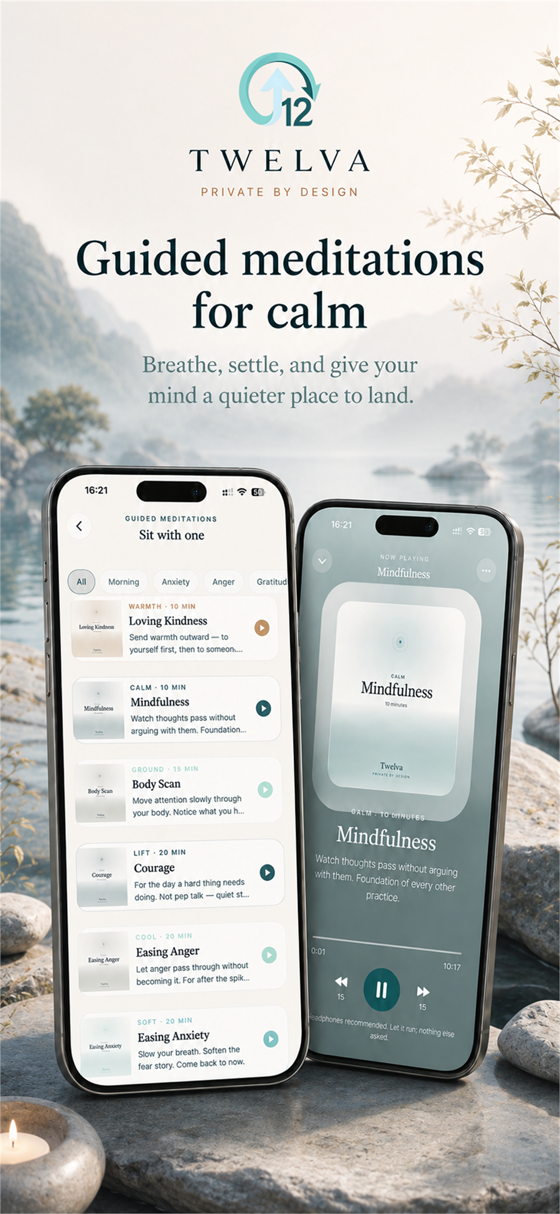

Twelva feels different from the moment you open it. No clutter, no manipulative gamification, no intrusive notifications. There are streaks and milestones, because progress deserves to be visible — but no leaderboards, no guilt loops, and nothing you lose for good because of one bad day. Just a quiet, considered space for the honest work that recovery asks of you.
Twelva isn't a bucket of disconnected tools. It's a simple, repeatable practice: reflect honestly, breathe, notice your patterns, write it down, and come back tomorrow.
Begin with truth each day through carefully structured prompts that invite honest self-examination without sounding cold, clinical or generic.
Fast starts. Clear next actions. Calm transitions. Breathing sessions help regulate the nervous system without turning the experience into wellness theatre.
Notice the patterns underneath the day — hungry, angry, lonely, tired — and build more self-awareness before things spiral.
Purpose-built for recovery rather than general chat. It keeps the conversation anchored to your recovery and is available free with usage limits; Twelva Plus adds unlimited messaging.
Write freely, search your entries, and build memory out of insight. The journal stays with the person who wrote it.
Your journal lives on your device. Cloud sync is optional. We never sell your data and never use it to train models.
The path begins with truth. This step helps users face what addiction has touched without collapsing into shame or vagueness.
The journey begins with the hardest truth: admitting that self-will alone is not enough. Through 30 days of guided reflection, users move beyond denial and begin to name the impact addiction has had on relationships, health and self-respect — with honesty, not self-condemnation.
Hope reintroduces possibility. It gently widens the horizon after powerlessness has been named.
After truth comes hope. This step opens the door to believing that change is genuinely possible. It invites users to notice destructive loops, re-examine old thinking, and begin imagining a life shaped by steadier guidance and something greater than self-will.
Surrender reframes letting go as relief, not defeat.
Surrender is not weakness. It is the end of exhausting self-control as a strategy. This step helps users practise release, trust the process, and experience the strange peace that arrives when control stops being the centre of the story.
Inventory turns vague shame into named patterns that can be understood and changed.
This is the deep internal work. Users build a structured inventory of resentments, fears, harms caused and recurring character patterns — while also naming strengths and assets. Clarity replaces fog. What can be seen can be worked with.
Confession breaks secrecy and isolation by moving truth into relationship.
Secrets lose power when spoken aloud. This step guides users through sharing honestly with a trusted person, turning private insight into relational healing. Being fully known does not have to end in rejection; it can create relief, connection and dignity.
Readiness makes space for real willingness instead of performative change.
Before change can happen, genuine willingness must take root. This step honours the ambivalence many people feel and helps them move from knowing they should change to becoming truly ready to release what no longer serves recovery.
Humility offers honest self-knowledge without humiliation.
Humility is not self-erasure. It is truthful self-understanding held with dignity. This step helps users ask for help, loosen the grip of ego, and cooperate with change over time rather than demand instant transformation.
Willingness extends outward by preparing the ground for repair.
Recovery extends beyond the self. This step helps users create a thoughtful list of people harmed and build sincere willingness to make things right. It is not about guilt for its own sake; it is preparation for repair, honesty and mended relationships.
Amends becomes courage in action.
Healing becomes practical here. Users work through direct, indirect and living amends with wisdom and care. Not every amend can be made, but each act of honest repair clears space, restores trust and reduces the emotional debris that can fuel relapse.
Maintenance builds a daily rhythm that keeps recovery current and alive.
Recovery is not a destination. It is a way of living. This step strengthens the habit of regular self-examination, quicker ownership of mistakes and steadier awareness, helping users prevent resentment and shame from quietly accumulating.
Connection turns belief into lived spiritual practice.
This step deepens spiritual life through prayer, meditation and attentive quiet. Whether experienced through breath, stillness, community or faith, it helps users cultivate peace, clarity and the sense that they are not carrying life alone.
Service completes the circle by turning recovery outward.
The journey comes full circle here. Users move from private awakening into outward care, carrying what they have learned into service, presence and generosity. One of the strongest ways to keep recovery is to live it where others can feel it.
Built on trust, not extraction. Twelva stores your reflections, moods, and journal on your device by default. Cloud sync is opt-in and off until you turn it on. We never sell your data and never use it to train models.
Your recovery journal, mood history, HALT check-ins, and step progress live on your phone unless you choose to sync. We treat mental-health and recovery data as the sensitive information it is — never sold, never used for ad profiling.
Twelva is free to download and free to use. Start with the recovery tools that matter now; upgrade only if you want the expanded experience.
Final pricing is always shown by the App Store or Google Play before you subscribe.